Related Articles

Electric cars are becoming one of the most popular choices for modern transportation. As people look for cleaner, quieter, and more efficient ways to travel, electric vehicles are attracting attention around the world. Unlike traditional cars that use petrol or diesel engines, electric cars use electricity to power an electric motor. This basic difference changes the way the vehicle is powered, maintained, and driven.
Understanding what electric cars are and how they work can help people make better decisions when choosing a vehicle. Electric cars may look similar to regular cars from the outside, but their technology is quite different. They use batteries, electric motors, charging systems, and electronic controls to provide power and movement.
What Is an Electric Car
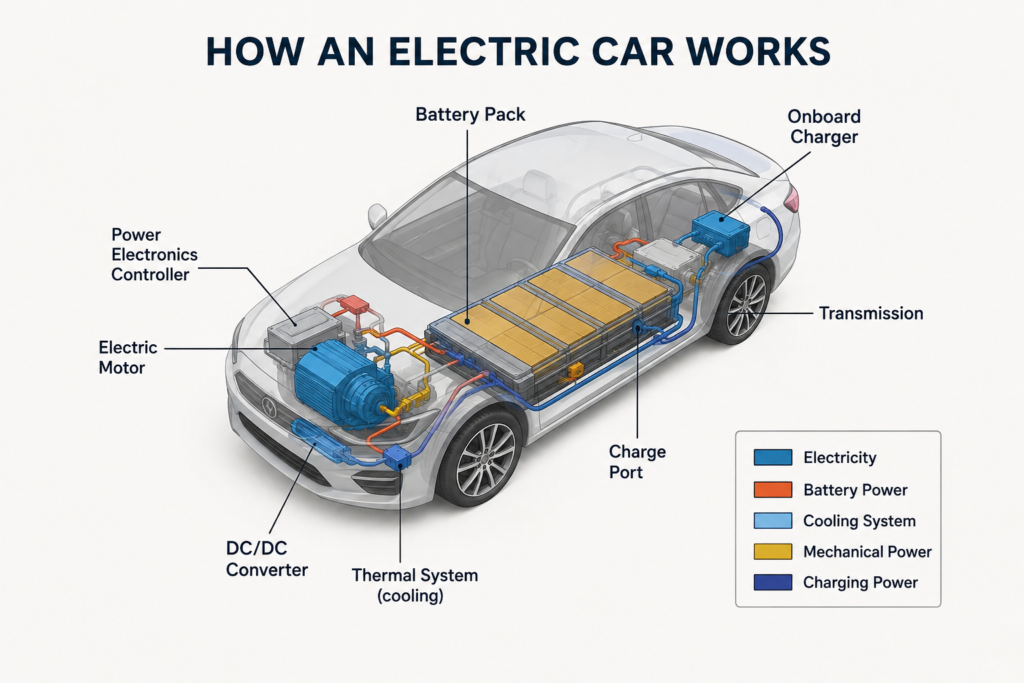
An electric car is a vehicle that uses electricity as its main source of power. Electricity is stored inside a large rechargeable battery pack. When the driver starts the car, electrical energy from the battery is sent to the electric motor. The motor then converts that electrical energy into mechanical energy that turns the wheels.
Most electric cars do not need petrol or diesel. This means they do not depend on a traditional internal combustion engine. Instead, their main power system includes a battery, electric motor, inverter, charging system, and electronic control units.
Electric cars are often called EVs, which means electric vehicles. Some EVs are designed entirely around electric power, while other vehicles combine an electric motor with a petrol engine. Fully electric cars are commonly known as battery electric vehicles.
How Do Electric Cars Work
The working process of an electric car is easier to understand when you look at the main components. Each part has an important job in moving the vehicle.
The battery stores electrical energy. When the driver presses the accelerator, the vehicle control system tells the battery to provide electricity to the motor. The inverter manages the flow of electricity and supplies the correct type of electrical power to the motor.
The electric motor uses this electricity to create movement. It turns the drivetrain, which transfers power to the wheels. As the wheels rotate, the car moves forward or backward depending on the driver’s controls.
This process happens quickly and smoothly. Unlike a petrol engine that needs fuel combustion to create power, an electric motor produces movement through electromagnetic forces.
The Electric Car Battery
The battery is one of the most important parts of an electric car. It stores the electricity needed to operate the vehicle. Modern electric cars commonly use lithium ion battery technology because it can store a large amount of energy while keeping the weight manageable.
The battery pack contains many individual battery cells. These cells are connected together to provide the required voltage and energy capacity. The size of the battery affects how far the car can travel on a single charge.
A larger battery can usually provide a longer driving range, although vehicle weight, driving conditions, speed, temperature, and other factors also affect range.
Electric car batteries are managed by a battery management system. This system monitors battery temperature, voltage, charging levels, and overall performance. It helps protect the battery from unsafe operating conditions and supports efficient battery use.
The Electric Motor
The electric motor is responsible for turning electrical energy into movement. It is one of the major differences between electric cars and traditional vehicles.
When electricity reaches the motor, electromagnetic forces cause its internal components to rotate. This rotation is transferred to the wheels through the drivetrain.
Electric motors can deliver strong torque very quickly. This is why many electric cars can accelerate smoothly and quickly from a stop. The driver does not normally need to wait for the motor to build up power in the same way that some traditional engines do.
Electric motors are also generally simpler than combustion engines because they contain fewer moving parts. This can reduce certain maintenance requirements.
The Role of the Inverter
The inverter is another important component in an electric car. The battery stores electricity in direct current form, while many electric motors operate using alternating current.
The inverter converts the electrical power into the form required by the motor. It also controls how much power reaches the motor based on the driver’s acceleration input.
When the driver presses the accelerator, electronic systems determine how much electricity should be delivered. The inverter then manages the power flow to produce the desired level of motor performance.
How Electric Cars Are Charged
Electric cars need to be recharged after their stored battery energy is used. Charging can take place at home, at workplaces, or at public charging stations.
Home charging is convenient for many owners because the vehicle can be plugged in while it is parked. A standard home charging system may be suitable for overnight charging, while a dedicated charging unit can provide faster charging.
Public charging stations can offer different charging speeds. Some provide relatively slow charging, while fast charging stations can add a significant amount of battery energy in a shorter period.
Charging time depends on the battery size, charger power, vehicle charging capacity, and current battery level. For this reason, charging times can vary considerably between electric car models.
Regenerative Braking
One of the most interesting features of electric cars is regenerative braking. In a traditional car, braking converts much of the vehicle’s movement energy into heat through the brakes.
In an electric car, the motor can work differently when the driver slows down. During regenerative braking, the motor acts like a generator. It uses some of the vehicle’s movement to produce electricity, which can then be sent back to the battery.
Regenerative braking does not recover all of the energy used by the vehicle, but it can improve overall efficiency. It also reduces the amount of work required from the traditional friction brakes in many driving situations.
Advantages of Electric Cars
Electric cars offer several important benefits. One major advantage is lower direct emissions during driving. A fully electric vehicle does not produce exhaust gases from a petrol or diesel engine while it is operating.
Electric cars can also be highly energy efficient. Electric motors convert a large portion of electrical energy into movement, making them efficient compared with traditional combustion engines.
Another benefit is quieter operation. Electric motors generally produce much less mechanical noise than combustion engines. This can make driving more comfortable and can also reduce traffic noise.
Maintenance can also be different. Fully electric vehicles do not require regular engine oil changes because they do not have a traditional combustion engine. They may also have fewer engine related components that require servicing.
Challenges of Electric Cars
Although electric cars have many advantages, they also have some challenges. One of the biggest concerns for many drivers is driving range. People may worry that the battery will run out before they reach a charging station. This concern is often called range anxiety.
Charging infrastructure is another important factor. In areas with limited charging stations, long distance travel can require more planning.
The initial purchase price of some electric cars can also be higher than comparable petrol vehicles. However, running costs can be lower depending on electricity prices, fuel prices, driving habits, maintenance needs, and local conditions.
Battery performance can also be affected by extreme temperatures. Very hot or very cold conditions can influence charging speed, energy consumption, and driving range.
Electric Cars and the Environment
Electric cars can help reduce direct vehicle emissions and dependence on petrol and diesel. However, their overall environmental impact depends on several factors.
Electricity used to charge the battery may come from different sources. If electricity is generated from renewable sources such as solar or wind, the overall emissions associated with vehicle operation can be lower. If electricity comes mainly from fossil fuels, the environmental benefits can be different.
Battery production also requires raw materials and energy. For this reason, electric transportation should be considered as part of a larger effort to improve energy efficiency, recycling, renewable energy, and sustainable manufacturing.
The Future of Electric Cars
The future of electric cars looks promising as technology continues to improve. Manufacturers are working on batteries with better energy density, faster charging, longer life, and improved safety.
Charging networks are also expanding in many regions. As charging becomes easier and more accessible, electric cars may become more practical for a wider range of drivers.
Electric vehicles are also becoming available in different shapes and sizes. Small city cars, family vehicles, luxury models, pickup trucks, and performance cars are now available with electric power.
Conclusion
Electric cars are vehicles that use stored electrical energy to power an electric motor instead of relying mainly on petrol or diesel. Their main systems include a rechargeable battery, electric motor, inverter, charging system, and electronic controls.
The basic process is simple. Electricity is stored in the battery, controlled by electronic systems, delivered to the electric motor, and converted into movement. Regenerative braking can recover some energy when the vehicle slows down and return it to the battery.
As battery technology, charging infrastructure, and electric vehicle design continue to improve, electric cars are becoming an increasingly important part of modern transportation. Understanding how electric cars work makes it easier to appreciate their benefits, limitations, and potential role in the future of driving.